- 6 min reading
For as long as I can remember, resilience meant something pretty straightforward. You get knocked down, you get back up. A storm hits, you rebuild. A factory burns, you recover. The assumption underneath was simple enough, that disruptions are events. They have beginnings and endings. The world wobbles, then returns to its previous shape. That assumption is breaking.
We are no longer dealing with sporadic or one-off shocks anymore. Disruptions now overlap and spill into each other.
One. After. The. Other.
The month that made the point
On January 3rd, a coordinated arson attack by a left-wing extremist group severed high-voltage cables in Berlin, triggering the city's longest power outage since 1945. Temperatures dropped to minus ten. Trains stopped. Mobile networks failed. The city's mayor called it what it was, a terrorist attack on critical infrastructure. The target itself was not dramatic, just cable bridges carrying electricity. But the compunding effect cascaded through systems that had grown dependent on each other.
Days later, Storm Goretti swept across Western Europe. Amsterdam's Schiphol Airport cancelled over 700 flights in a single stretch. More than a thousand travelers slept in terminals. Icy roads paralyzed logistics across the region. These were not extraordinary weather events by historical standards, if I'm not mistaken (and if memory serves me well after living there for 13 years). They were ordinary winter conditions meeting systems with very little slack.
Meanwhile, Ukraine entered another winter (it's fourth) under intensified Russian attacks on energy infrastructure. The country's energy minister reported that not a single power plant remained untouched. Millions faced are facing freezing temperatures without reliable heating, electricity, or water. Repairs that would normally take weeks are nearly impossible under continuous bombardment.
And global shipping? The Suez Canal is cautiously reopening after two years of disruption from Red Sea attacks. Maersk sent its first vessel through in December. CMA CGM committed to a regular India-to-US East Coast service starting this year. Progress, certainly. Yet operators are returning route by route, hedging their commitments, still unsure whether the calm will hold.
These are the same story, told in different registers.
The shift regulators already see
Something interesting happens when you read how regulators now define resilience. The European Banking Authority describes operational resilience as "the ability to deliver critical operations through disruption." The Basel Committee uses nearly identical language. Notice that there's no mention of recovery timelines or restoration targets. The emphasis has moved from bouncing back to continuing through.
The Critical Entities Resilience Directive makes this concrete. EU Member States were required to submit national resilience strategies by January 17, 2026, a deadline that has now passed. By July, they must identify which organizations qualify as "critical entities" under the directive. Those organizations will face new questions from supervisors and boards--> How will you keep delivering under disruption? Where are the dependencies you have not stress-tested? What breaks first?
This is a very different posture. The old continuity plan sat in a binder, updated annually, invoked rarely. The new expectation is that continuity is demonstrated continuously.
Why this matters beyond compliance
Here is what changes when leaders accept that disruption is persistent.
If disruption is persistent, if it becomes a background condition rather than an occasional shock, then the organizations that thrive will be those designed for continuous adaptation. This changes how decisions get made across every function.
Procurement stops optimizing for lowest price and starts engineering for continuity. That sounds lofty until you translate it into the day-to-day when buyers need substitution options, faster verification, clearer supplier dependencies, and contracts that let them switch without a legal brawl. The Commission’s new cybersecurity package, published January 20, 2026, is a useful signal here because it shows the direction of travel where more scrutiny of supply chains, more emphasis on trusted dependencies, more expectation that organizations can manage strategic risk in what they buy. If disruption is constant, flexibility becomes a feature.
Planning shifts from a single forecast to a portfolio of options. Leaders who navigate uncertainty well tend to pre-decide their thresholds and responses. If the shipping route changes, inventory strategy changes. If weather knocks out transport, service delivery shifts. If a site becomes politically contested or logistically constrained, capacity moves. This is not necessarily a defeatist reaction but just faster decision-making under perpetual pressure.
Capital starts rewarding organizations that can keep operating. The ability to continue delivering (to customers, to communities, to regulators) becomes a source of value, distinct from the promise to rebuild eventually. Investors and insurers notice who maintained operations and who did not. Over time, that difference shows up in cost of capital, in contract terms, in reputational resilience.
A blind spot hiding in plain sight
Let's talk physical infrastructure. Buildings, where we excel.
We have extensive playbooks for supply chain flexibility, for cybersecurity response, for financial hedging. Yet when it comes to buildings for schools, clinics, logistics facilities, worker accommodation, border operations, maintenance bases, and the list continues, the default assumption remains strangely static.
Modular, relocatable, and circular facilities provide a complementary set of options such as rapidly deployable capacity that can be reconfigured, moved, or repurposed as conditions change. When designed to the same standards of safety, comfort, and performance as permanent structures, these solutions are not second best; they are alternative delivery models that extend an organization’s operational choices.
And space decides whether continuity works. If you cannot add capacity when you need it, your resilience strategy has a ceiling. If you cannot adapt facilities when requirements change, your flexibility ends at the building's walls.
If your infrastructure timeline runs in years while your operating environment shifts in months, there is a mismatch that no amount of procurement agility can fully overcome.
A lesson from an unexpected place
Ukraine's response to continuous infrastructure attacks offers golden insights.
DTEK, the country's largest private energy company, recently announced its biggest investment program in history, but the investment is not in large centralized power plants. It is in distributed generation, meaning wind, solar, storage, smaller assets spread across the grid. The reasoning is instructive. Large centralized facilities are easy to target, slow to repair, and catastrophic when lost. Smaller distributed assets are harder to hit, quicker to restore, and more capable of maintaining grid stability even when individual nodes fail.
The same logic applies to physical capacity in any sector. Distributed, adaptable infrastructure is harder to disrupt. Relocatable capacity can move when circumstances demand. Modular approaches allow organizations to scale up or down without betting everything on a single forecast.
So this is where industrialized or high quality modular construction deserves attention as a resilience capability talking point. Offsite approaches can concentrate risk in factories, components, and transport routes. Insurance and standards can lag, and supply chains can bottleneck.
Designing assets to move and deliver continuously
Add one more regulatory signal to the picture.
The European Commission's Circular Economy Act is expected in the third quarter of 2026. The framing is notable, positioned explicitly as competitive and industrial resilience policy. The goal is to double the EU's circular material use rate to 24% by 2030. In laymen's terms, Europe wants business models that rely less on volatile virgin inputs and more on retained value through reuse, refurbishment, and redeployment.
Circularity is often discussed as an environmental imperative. It is that. Yet it is also, and predominantly, a resilience strategy. Meaning, Europe wants business models that rely less on volatile virgin inputs and more on retained value through reuse, refurbishment, and redeployment. If you can avoid supply-chain headaches and higher emissions, and rely on ready availability, this is a no-brainer.
The epiphany, stated plainly
The old model of resilience assumed the world eventually returns to normal. You absorb the shock, you recover, you resume. The planning horizon resets.
The emerging reality is different. Disruption is becoming the normal state. We see increasing natural disasters, geopolitical fragmentation is accelerating, infrastructure systems are aging while threats to them multiply. So the wishful thinking of how quickly you can return to the previous equilibrium is exaclty that, wishful thinking. We must plan for whether we can keep adapting as equilibrium itself keeps shifting.
This requires a different kind of infrastructure, both physical and organizational. It requires procurement designed for substitution. Supply chains designed for rerouting. Planning designed around options rather than predictions. And facilities designed to move, adapt, and retain value across multiple uses and locations.
Our *new resilience* agenda
Adapteo provides high-quality modular buildings designed for precisely this operating environment. High quality modular assets that can be reused, relocated, and reconfigured reduce stranded-asset risk.
Circularity becomes operational where reuse cycles, standardized components, predictable refurbishment, and measurable avoided new production. This is competitiveness too, since it can lower exposure to materials volatility and delivery delays, and it can support public and private clients who need capacity now without locking themselves into a single forecast for the next 30 years. And with quality that remains good-as-permanent.
It is also resilience made tangible. Space becomes a managed resource rather than a sunk cost. Capacity becomes something you can dial up or down in response to actual demand. The timeline mismatch between infrastructure delivery and operational reality starts to close.
Europe's construction sector faces persistent skilled labor shortages, an estimated 2 million additional workers needed by 2030, with construction accounting for 44% of all EU job shortfalls. Industrialized modular methods shift more work into controlled factory environments, reduce on-site exposure to weather volatility, and shorten the period where projects depend on scarce local trades. Sure, this does not eliminate risk but it changes the risk profile in ways that suit a disruption-heavy operating environment.
The leadership takeaway is pretty much smacking us across the face
Every organization dependent on physical capacity should be asking a simple question: For each critical facility, if this location becomes constrained or this demand shifts in eighteen months, what is our option?
If the answer is "rebuild from scratch" or "hope the forecast holds," there is a resilience gap hiding in the infrastructure strategy.
Leaders who treat space as flexible infrastructure, supported by industrialized modular delivery and genuine circularity, gain something rare in a disrupted world. They gain the ability to keep going without pretending the world will settle down.
This is an operating posture for the era we have actually entered.
✌️
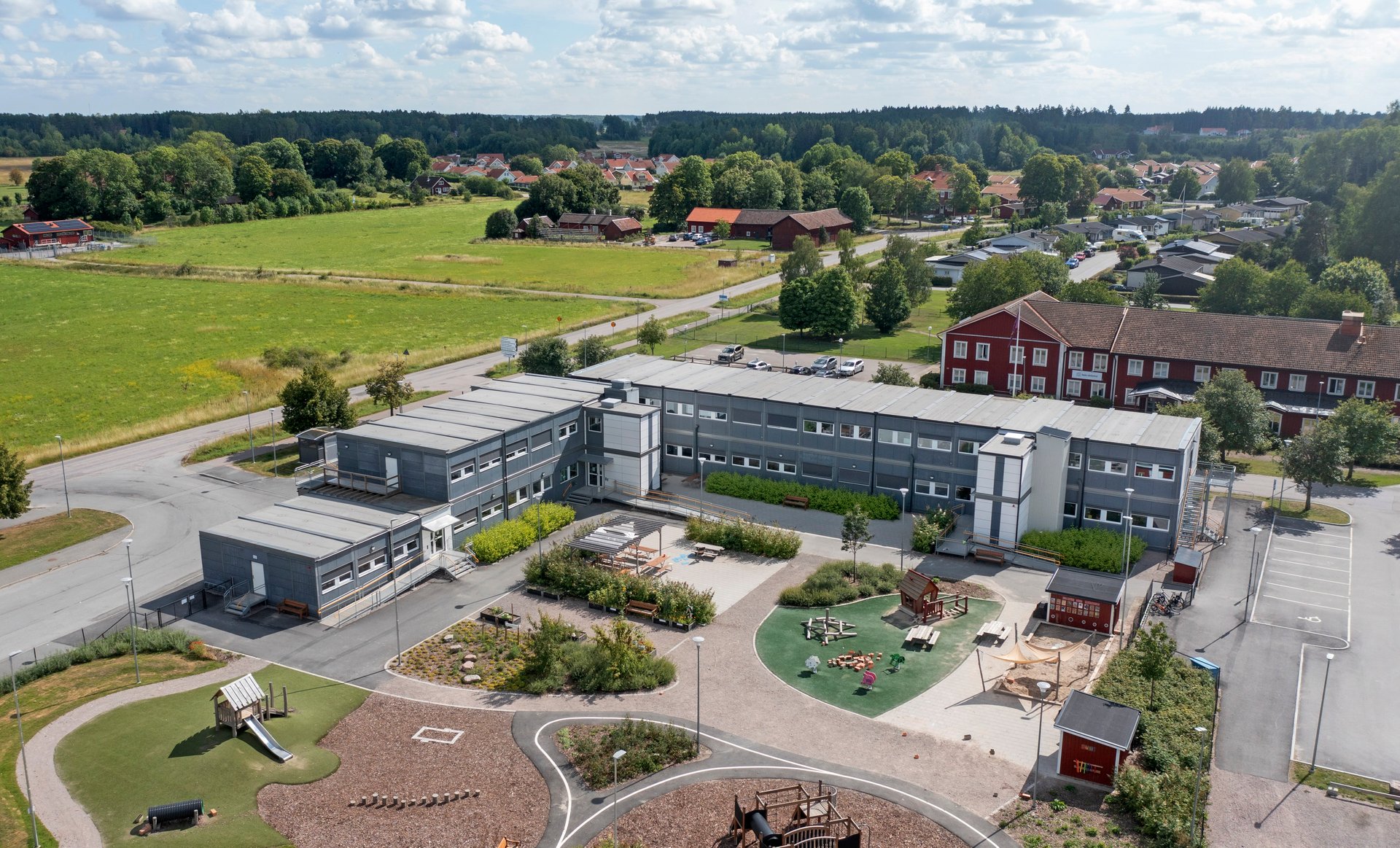
Image: A school in Gavsta, Sweden by the Adapteo Sverige team